What is Experiential Education? |
Experiential Education is a philosophy in which educators engage directly with students through direct, hands-on experience in order to build knowledge, skills and values. That is to say, Experiential Education refers to learning-by-doing, then reflecting on one's own experiences.
Experiential Education is most valuable because students make their own discoveries by experiencing themselves, rather than relying on learning indirectly through what they have read or heard about others' experiences. Students then reinforce what they have learned through reflecting on their direct experiences.
Experiential Education is the overarching philosophy of outdoor education, environmental education, teambuilding, adventure-based programs, ropes course activities, and service learning.
|

|
|
Why is Experiential Education so Effective?
|
Learning by experience is so effective because it combines simultaneous development in the three core domains of learning (Bloom's Taxonomy): Cognitive (or knowledge acquisition), Affective (or emotional attitudes) and Psychomotor (or skills). By providing an 'experience' that the learner lives, the learning is reinforced in the learner - by thinking, feeling and physically doing something.
There are some values of Experiential Education in the Outdoor Education setting. Sabre Corporate Development (Australia) have pointed out that it provides opportunities for: |
- Equality - It provides a common and yet novel experience where all participants are equal in their knowledge about the tasks and projects that will confront them. A unique set of projects and situations requires people to draw upon genuine team process skills as opposed to just functional ones.
- Developing relationships quickly - Participants are interacting in close proximity whilst working on new and unfamiliar challenges. The communication, collaboration and efforts that are required to meet these challenges develops relationships quickly. People may get to know each other better in a single day within this environment than over an entire year of normal life.
- Disequilibrium - The unfamiliarity of the challenges and problems places people in a state of disequilibrium or disorder. They cannot easily stand behind their normal status, roles and defenses. Prior experience isn't as relevant in this environment. This can allow emphasis to be placed upon both task and process related themes as the group has to organize itself around the challenge.
- Projective technique - In organizing the instability or disequilibrium, the group projects their problem-solving skills, management abilities, and leadership abilities onto the experience. The experience provides a unique opportunity to catch participants doing what they typically do, in spite of knowing otherwise. The learning arising from this is profound and revealing. The window or mirror into their process provides unlimited information to shape their team based learning.
- Decreased time cycle - The space between the project or challenge and the outcomes are compressed, so the consequences of decisions can be easily examined and improved. Typically in school, there is more of a time lag and more variables to consider, so any review of learning risks being diluted or delayed.
- Meta Learning - In the experiential learning realm, as the tasks and simulations shed light on the teams’ process, the group is asked to step back and evaluate their performance. The review is about themselves, their leadership, problem solving skills, teamwork, communication and ability to manage change. The intensity with which these issues can arise, and then be discussed in this environment, is superior to that which normally occurs in life.
- Chaos and Crisis in a Safe Environment - Teams are able to experience chaos, disorder, crisis and changing requirements for success in a safe environment where the consequences for failure are limited. The team can develop strategies and practices for managing these issues both in this environment and back at school.
- Kinesthetic Imprint - Experiential learning is an anchor for cognitive material. Participants have a kinesthetic imprint or whole body learning of cognitive principles because the learning is graphic - it involves physical, mental and behavioral dimensions.
- Common Language - The experience provides a common language, experience and story, which can be related ‘real life’. The experience can provide a short cut in communicating a shared vision very quickly. The experience is stored in a way that is able to permit participants to see themselves and their classmates in a new light. The experience (and stories attached thereto) can serve as a catalyst for continuing the learning theme back at school.
- Encourage Risk Taking - The experience allows participants to take new risks, try on new roles and make mistakes with no danger or cost. Risks are naturally perceived rather than actual. Each person taking a risk pushes others to take on something outside of their comfort zone. There are always individuals who shine in this environment - whose leadership ability hasn't been noticed prior at school.
- Diversity of Strengths - The team challenges and activities are designed to include a variety of elements that will challenge a range of team role skills. In other words, input from all team members will be required to produce outcomes from projects specifically designed not to suit just one team role style or behavior. One person cannot possibly succeed alone and so the interdependence of the team is highlighted along with the importance of diversity within the team.
- Fun - This environment provides a highly enjoyable way to learn about and develop team and leadership skills. Fun is a powerful aspect of effective learning with participants becoming more open to the experience and creative, whilst participating in it.
|


|
|
What sets Berkshire Outdoor Center Apart from its Competitors? |
 |
The Berkshire Outdoor Center runs all of its activities based on the philosophy of Experiential Education - that hands-on experience builds knowledge, skills and values. Our programs run outdoors, are student-centered, and are fun, safe, healthy opportunities for students to learn about themselves, each other and the world around them.
Philosophy of Challenge By Choice - The Berkshire Outdoor Center follows the popular philosophy of Challenge By Choice. While participants are encouraged to participate in the activities, each participant chooses his or her own goals and challenges for the course. Participants are never coerced or required to participate. Participants choose their own level of participation - encouraged only to consider stepping outside their comfort zone. Facilitators assist in helping participants experience some level of success.
Tailorable Programs - We tailor our programs for every group that attends. Leadership Development packages include low and high ropes courses. Other Outdoor Education packages include teambuilding and low ropes courses. Any of our activities can be added to any of our packages. For example, a few schools that attend our fall programs love the high ropes courses focus, but like to add ecology (nature) and kayaking (adventure) to the activities for their students. Full Listing of Activities Offered by Berkshire Outdoor Center
|
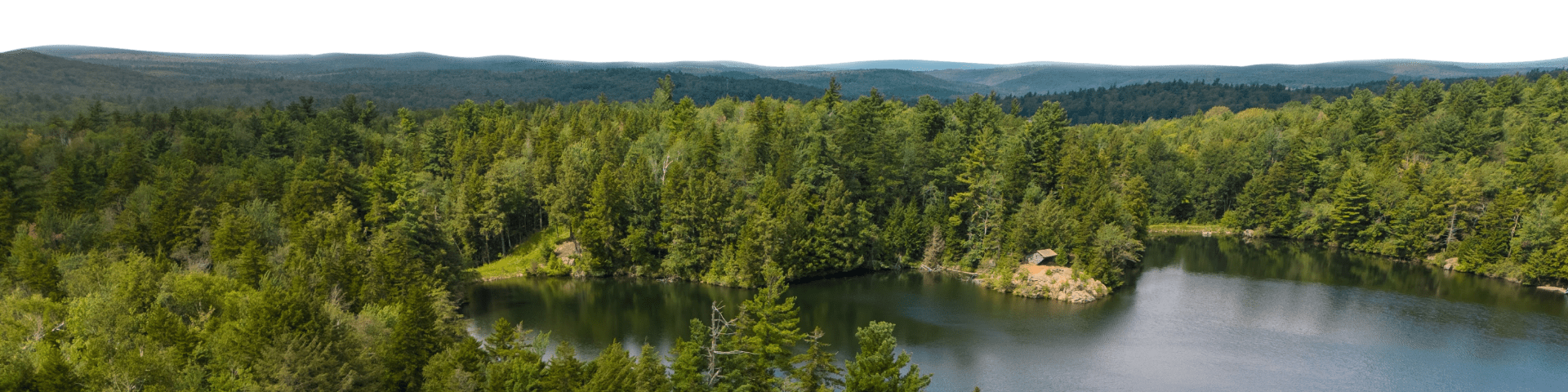
World-Class Facilities - The Berkshire Outdoor Center operates world-class facilities in a gorgeous rustic setting in the Berkshire Hills of Massachusetts.
- Our ropes courses are state-of-the-art and are located on each of our two beautiful camps - Camp Becket and Chimney Corners.
- Our brand new $5.5 million Chimney Corners Dining Hall is the perfect venue for meals and meeting spaces. One of our three climbing towers is even located inside this magnificent building!
- Our rustic Camp Becket Dining Hall overlooks the beautiful Rudd Pond for simply gorgeous views.
- We have three spectacular ponds, and we own all the land around each of them, so activities on the ponds are exclusively those of the Berkshire Outdoor Center.
- Our camps are on 1,350 acres of forested conservation lands. The property includes an extensive wetlands system and even a pristine peat bog - the perfect venues for Environmental Education programs.
- Our accommodation includes more than 70 rustic cabins arranged into 7 villages - with over 700 beds and four winterized lodges with up to 165 beds.
Exceptional International Staff - Our instructors are the best asset to our programs. A diverse range of staff from a variety of countries return year after year to run our Outdoor Education programs. The extensive cultural diversity and interesting perspective each of them brings to our organization and to our guests is truly an exceptional contribution to the programs. And our seasoned veterans are the best staff in their field, passionate about living and working here in the Berkshires. |
|
|
|
|
|